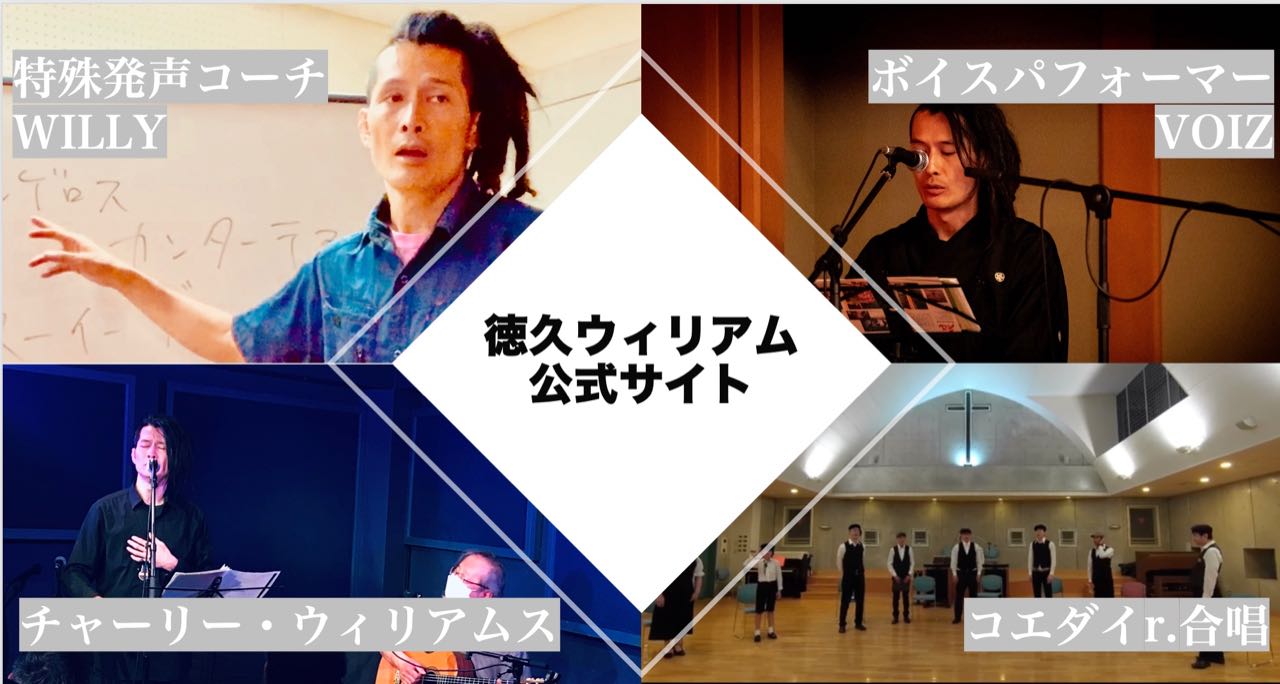

William Tokuhisa
WILLy — voice artist
khoomei, noise voice, prepared jaw harp, improvised speech
Video: Environmental Sound and Improvisation, Matsu no Mori Kugenuma, Fujisawa, May 2026
ARTIST STATEMENT
Sound has three elements: pitch, rhythm and timbre. In Japan, and across much of Asia, the weight falls on timbre. That is where my work lives.
I see traditional music as a chemical reaction between people and the soundscape they lived in. What survives is what remained after an enormous amount of play and experiment. My question is what could stand up to that strength, coming only from the reaction between myself and the land I have lived in.
Noise music is, I think, the folk music of the city. Its mainstream is machine noise. I work with noise made by the voice alone — not imitating machines, but working in the territory of sound that only the voice can produce.
Two other practices extend this. The first is the prepared jaw harp: an instrument that lets the listener feel the voice from the outside, and whose timbral range I extend through preparation. The jaw harp carries an incantatory quality that the voice once carried too, before it became a commodity. The contrast is part of the work — the visible labour of the hands on the instrument, set against passages where I barely move and sound comes only from the mouth.
The second is improvised speech, a method I devised. Japanese has one of the largest inventories of onomatopoeia in the world, which makes sound poetry in the ordinary sense hard to establish here. I turn that around: I treat words head-on, but there is no continuity between the sentences.
My meditation teacher, Suigan Nakajima — a Shugendō mountain ascetic and former chief priest of Toyouke Inari Hongū, one of the few shrines in Japan that still keeps Shinto and Buddhism together — describes the ascetic as a marginal person: someone who keeps crossing the line between the sacred and the everyday. I recognise my own work in that. Under his supervision I developed Khoo Meditation, a method built on Tuvan khoomei and named after it, and since 2019 I have held it in more than twenty-five sessions, while also performing noise in live bars.
From 2009 I co-ran Kurayami no Tones (Tones in the Dark) with Hiroshi Tamura: events in which everyone present makes sound together in complete darkness. By 2015 there had been more than fifty. In the dark no one can see a face, skin or clothing; people stop worrying about being looked at, and their voices open. Dialogue in the Dark has long used darkness in the same spirit, to change how people meet what is “other.”
Again and again in Japan, what arrived from the continent was absorbed and reshaped until it could travel back out to the world. Buddhism merged with the local kami. The sword came from the mainland, and the way of using it became a Japanese art; judo and karate — the latter grown partly from Chinese martial arts — are now practised by people of every faith and background. Even food follows this path: this summer, in a supermarket in Berkeley, I found Japanese katsu curry, assembled from India by way of Britain and a European cutlet, sold as “curry rice.” What carries such things beyond their origin is kata — a device that lets a technique cross eras, places and peoples, a restriction inside which expression deepens rather than narrows.
The jaw harp is already one of the most widely distributed instruments on earth, and it sounds through the resonance of the mouth. Humans are genetically more alike than chimpanzees are among themselves; we share the same mouth and throat, and that shared body is where both the voice and the jaw harp begin. I am now working to bring khoomei, the jaw harp and the voice into kata of their own: through making them Japanese, to find something that belongs to no single place.
WORKS
Prepared Jaw Harp, Noise Voice and “Noizu Karaoke”, 2026
Improvised Speech, 2026
Khoo Meditation, 2022–23
SELECTED
- 2026
Mama Santos, Kilowatt, San Francisco, USA — duet on prepared jaw harps with Tatiana; noise voice and bilingual improvised speech; “noizu karaoke”
- 2026
Fading Echoes II / Encounter of Asia and the West, dir. Hiroshi Koike, Odyssey Creative Center, Tokyo — solo jaw harp and voice
- 2025
Invited artist (travel and accommodation fully covered), 10th International Jew’s Harp Congress and Festival, Akan-ko Ainu Kotan, Hokkaido, Japan
- 2021–22
Galaxy 2072, dir. Hiroshi Koike — lead role (feature film)
- 2017–18
The Man from the Sea, dir. Koji Fukada — khoomei and voice recordings; voice coaching for lead actor Dean Fujioka
- 2017
World Conference, dir. Hiroshi Koike — voice and jaw harp; co-composer
- 2012
Southeast Asia tour with TAIKUH JIKANG (voice) — Museum Topeng, Bali, Indonesia; The Actors Studio @ Lot 10, Kuala Lumpur, Malaysia (supported by the Japan Foundation, Kuala Lumpur)
- 2011
Selected, TOKYO EXPERIMENTAL FESTIVAL, Tokyo Wonder Site, Tokyo — Creating a Forest of Voices, Kurayami no Tones: participatory performance for 20 voices in total darkness
- 2008
Selected and Audience Award, 3rd Sound Performance Dojo, Aichi Arts Center, Nagoya — VOIZ, solo voice performance
TEACHING
Voice coach in traditional and extended vocal techniques, 1999–present. Guest lecturer, Faculty of Letters, Keio University; lecturer, Meiji Univ. Liberty Academy; invited instructor, Performing Arts Institute (P.A.I.), directed by Hiroshi Koike.
Classes (Japanese)Newsletter (Japanese)
CONTACT
Legal notice (Japanese)Privacy policy (Japanese)
© 徳久ウィリアム William Tokuhisa